
Has the moon been up there
All these nights
And I never noticed?
A whole week with my nose
To the ground, to the grind.
And the beloved faithfully
Returning each evening
As the moon.
Where have I been?
Who has abandoned whom?
GREGORY ORR
Has the moon been up there
All these nights
And I never noticed?
A whole week with my nose
To the ground, to the grind.
And the beloved faithfully
Returning each evening
As the moon.
Where have I been?
Who has abandoned whom?
GREGORY ORR
I am finding a deepening love and concern for what is happening to our beautiful planet. The poet Reiner Maria Rilke (translated by Joanna Macy and Anita Barrows) phrased it beautifully in his Book of Hours which has been on and off my bedside table for several years now:
Dear darkening ground,
you’ve endured so patiently the walls we’ve built,
perhaps you’ll give the cities one more hourand grant the churches and cloisters two.
And those that labor—let their work
grip them another five hours, or seven,before you become forest again, and water, and widening wilderness
in that hour of inconceivable terror
when you take back your name
from all things.Just give me a little more time!
I want to love the things
as no one has thought to love them,
until they’re worthy of you and real.
And I continue to be very curious about how mindfulness can help in that quest to love the things as no one has thought to love them. It seems to me that a lot of the current climate crisis can be met by looking deeply, acting mindfully and lovingly. And so I find myself wondering… what is my place in the family of things, how am I connected to others? How can I contribute to a healthier thriving planet on a day-to-day basis? Where do my clothes come from, who has grown my food and where, what are the conditions of their lives and how is their environment treated, what resources are used to package my food and what happens to it after it has served its purpose? What are the lives of the animals like that are producing the eggs and milk I consume, and how is the animal agriculture that I’m supporting with my purchases contributing to climate change?
This topic occupies my bedside table at the moment: Stephanie Kaza’s Mindfully Green, Thich Nhat Hanh’s Love Letter to the Earth, Joanna Macy’s Active Hope: How to Face the Mess We’re in Without Going Crazy.
I find I’m having to work hard at staying connected and balanced in the midst of the amount of suffering I see when looking more deeply at the interconnectedness of all things and therefore, my contribution to it. It’s easy to fall into overwhelm and then shrink away in apathy, distraction and numbness, or flip the other way into black and white fanaticism and deadly criticism of myself and others (and it’s not hard to see how harsh criticism then flips me back into apathy). It’s taking all my mindfulness and then some, to inch towards where it hurts – while also consciously directing my gaze to the deep gratitude and my love and sheer beauty of life.
I find Joanna Macy’s wise voice a continuous inspiration and encouragement. In a short video she talks about Embracing Suffering and ends with saying in such a definite and knowing way that “despair is the covering of our love for our world, and we crack it open by speaking it so that our love can act. So the key is not being afraid of our pain for the world. Not being afraid of the world’s suffering. And if you are not afraid of it… then nothing can stop you.”
And not only can nothing stop you, but it allows you to live as Hafiz described:
One regret, dear world,
That I am determined not to have
When I am lying on my deathbed
Is that I did not kiss you enough.
Indeed!
So may we all live in a way that allows our self, our fellow beings and this precious planet we call our home to be well and flourishing…
 Dear darkening ground,
you’ve endured so patiently the walls we’ve built,
perhaps you’ll give the cities one more hour
and grant the churches and cloisters two.
And those that labor—let their work
grip them another five hours, or seven,
before you become forest again, and water, and widening wilderness
in that hour of inconceivable terror
when you take back your name
from all things.
Just give me a little more time!
I want to love the things
as no one has thought to love them,
until they’re worthy of you and real.
– Reiner Maria Rilke, translated by Joanna Macy and Anita Burrows
The daily life practice of the Self Compassion Break, as developed by Kristin Neff, has been invaluable to me countless times over the years. It takes some of the sting out of whatever difficulty presents itself, as soon as I remember to connect with it and hold myself with tenderness in the pain of it. Although I had practised self compassion for many years, I was surprised about how inspired I felt when I first read Kristin Neff’s book Self Compassion – the Proven Power of Being Kind to Yourself. Apparently there was still a part of me that believed that I just had to shape up and shut up, rather than be kind to myself when the shit hit the fan…
As the cover says:
Dr. Neff helps readers understand that compassion isn’t only something that we should apply to others. Just as we’d have compassion for a good friend who was going through a hard time or felt inadequate in some way, why not for ourselves? Many people believe that they need to be self-critical to motivate themselves, but in fact they just end up feeling anxious, incompetent and depressed. Dr. Neff’s research shows that far from encouraging self-indulgence, self-compassion helps us to see ourselves clearly and make needed changes because we care about ourselves and want to reach our full potential.
A further recommendation to this book came from an MSc student who said it ‘read like a novel’. You can’t say that of many mindfulness and compassion books! So below the short practice of:
THE SELF-COMPASSION BREAK
Think of a situation in your life that is difficult, that is causing you stress. Call the situation to mind, and see if you can actually feel the stress and emotional discomfort in your body. Now, say to yourself:
1. This is a moment of suffering
That’s mindfulness. Other options include: This hurts. Ouch. This is stress.
2. Suffering is a part of life
That’s common humanity. Other options include: Other people feel this way. I’m not alone. We all struggle in our lives.
Now, put your hands over your heart, feel the warmth of your hands and the gentle touch of your hands on your chest. Or adopt the soothing touch you discovered felt right for you. Say to yourself:
3. May I be kind to myself
You can also ask yourself, “What do I need to hear right now to express kindness to myself?” Is there a phrase that speaks to you in your particular situation, such as: May I give myself the compassion that I need. May I learn to accept myself as I am. May I forgive myself. May I be strong. May I be patient.
This practice can be used any time of day or night, and will help you remember to evoke the three aspects of self-compassion when you need it most.
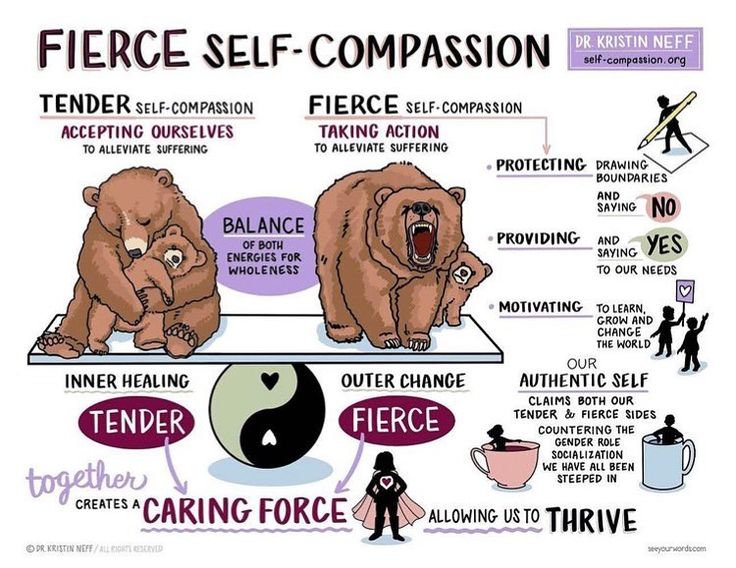
More recently Kristin Neff has written another book: Fierce Self-Compassion. To be honest, I was a little less enthusiastic about the book itself, but I am very glad that she named this other – but equally important!- aspect of self-compassion. There are many people, including a lot of women, who may really benefit from being encouraged to include in their practice the three aspects of fierce self-compassion that Kristine Neff names. She has a number of guided practices around this on her website that I’ve found super helpful. I feel the below sums it up pretty well…
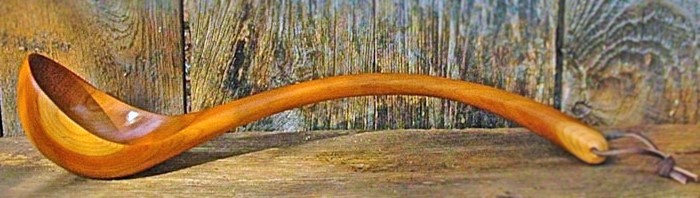
“At the banquets of life, bring a big spoon.”
What Is Taking In?
• In a profound sense, we are what we remember – the slow accumulation of the registration of lived experience. That’s what we have “taken in” to become a part of ourselves. Just as food becomes woven into the body, memory becomes woven into the self.
• Two kinds of memory: Explicit and Implicit.
– Explicit: Recollections of specific events.
– Implicit: Emotions, body sensations, relationship paradigms, sense of the world.
• Implicit memory – emotional/somatic memory – is different from remembering ideas or concepts: this kind of memory is in your “gut.” It’s visceral, felt, powerful, and rooted in the most ancient and fundamental structures of your brain.
• The sense of self, of what it feels like to be you, is rooted in emotional/somatic memory. That’s why it’s crucial to take real good care of what’s contained in those memory banks.
The Importance of Taking In Positive Experiences
• Negative experience is registered immediately: helps survival.
• Positive experiences generally have to be held in awareness for 5 – 10 – 20 seconds for them to register in emotional memory.
• Negative experiences trump positive ones: A single bad event with a dog is more memorable than a 1000 good times.
• Experiments with learned helplessness: great illustration of the enduring power of negative experiences compared to positive ones.
• Therefore, it is SO IMPORTANT to consciously, deliberately help the brain register positive experiences so they sink into the deepest layers of your mind. The benefits:
– Generally positive internal emotional landscape, atmosphere, climate.
– The fundamental foundation of self-soothing, emotional self-regulation, resilience.
– Positive expectations about oneself, others, and the future. This is the legitimate basis of “verified optimism.”
– It’s also the basis of true faith or confidence in your spiritual path.
– “Evoked others,” the sense of others inside who are nurturing, encouraging.
– In psychological terms, this is the mechanism of what’s understood as the internalization of positive resources.
– A crucial resource inside and pathway for healing from trauma.
• All this is about being in reality, not wearing rose-colored glasses:
– It’s about proportionality, about our sense of the world being consistent with the nature of the world. For example, if the “mosaic” of life is mainly good, shouldn’t our sense of living itself be mainly good?!
– It’s about learning from new positive experiences – having them make a difference. It’s about using new positive experiences to counterbalance old negative ones.
• From a spiritual perspective, you are helping yourself really sense and then register good experiences on the path, or that come with skillful practice (e.g., the sukha, or deep happiness of peaceful meditation). This has many benefits:
– Highlight the milestones along the way, so you can know what they feel like and find your way back to them.
– Build faith and confidence in the fruits of the path.
– Reward yourself for doing something that’s noble but not always easy, and thus support your ongoing motivation.
– More easily tap into the peace, contentment, and basic well-being that are the preconditions for deep states of concentration and insight.
How to Take in the Good
The Science
Since you are building up records of experiences in your most visceral memory banks, you need to focus on the emotional and body sensation aspects of your positive experiences. Through the mindfulness skills you’ve already learned, really tune into the embodied sense of the good experience. For example, relax your breathing and extend your awareness into the felt sense of the experience in your body.
General Attitudes
• Being in reality. You are just being fair, seeing the truth of things. You are not being vain or arrogant – which distort the truth of things.
• You’ve earned the good times: the meal is set before you, it’s already paid for, and you might as well dig in!
• Recognize the value to yourself and others of taking in positive experiences. It is a good, a moral, a virtuous thing to soak in good experiences. Even from a spiritual perspective, positive emotional states support practice through freeing up attention, building confidence and faith in the path, and fueling heartfelt caring and kindness for others.
Try to be aware of any attitudes that say it’s vain, selfish, sinful, or somehow unfair to feel good — especially about yourself. Explore those attitudes — and then let them go by relaxing your body, releasing the emotions embedded in the attitude, and disputing in your mind the illogical beliefs in the attitude.
Specific Actions Inside Yourself
#1 Help positive events to become positive experiences for you. You can do this by:
• Paying attention to the good things in your world, and inside yourself. This includes pretty sunsets, nice songs on the radio, chocolate!, people being nice to you, the smell of a baby’s hair, getting something done at work, finishing the dishes, holding your temper, getting yourself to the gym, feeling your natural goodheartedness, etc., etc. You could set a goal each day to actively look for beauty in your world, or signs of caring for you by others, or good qualities within yourself, etc.
• Maintaining a relaxed, accepting, spacious awareness.
• Setting aside for the moment any concerns or irritations, or at least nudging them to the background of your attention.
• Sometimes doing things deliberately to create positive experiences for yourself. For example, you could take on a challenge, or do something nice for others, or bring to mind feelings of compassion and caring, or call up the sense or memory of feeling contented, peaceful, and happy.
#2 Extend the experience in time and space:
• Keep your attention on it so it lingers; don’t just jump onto something else.
• Let it fill your body with positive sensations and emotions.
• Savor, relish the positive experience. It’s delicious!
#3 Sense that the positive experience is soaking into your brain and body – registering deeply in emotional memory. Perhaps imagine that it’s sinking into your chest and back and brainstem. Maybe imagine a treasure chest in your heart. Take the time to do this: 5 or 10 or 20 seconds. Keep relaxing your body and absorbing the positive experience.
#4 For bonus points: Sense that the positive experience is going down into old hollows and wounds within you and filling them up and replacing them with new positive feelings and views. These are typically places where the new positive experience is the opposite of, the antidote to the old one. Like current experiences of worth replacing old feelings of shame or inadequacy. Or current feelings of being cared about and loved replacing old feelings of rejection, abandonment, loneliness. Or a current sense of one’s own strength replacing old feelings of weakness, smallness.
The “replaced” experience may be from adulthood. But usually the most valuable experiences to replace are from our youngest years. They are the “tip of the root of the dandelion,” the ones we need to pull to prevent the dandelion of upsets from growing back. The way to do this is to have the new positive experience be prominent and in the
foreground of your awareness at the same time that the old pain or unmet needs are dimly sensed in the background.
The new experiences will gradually replace the old ones. You will not forget events that happened, but they will lose their charge and their hold on you.
THIS IS A PROFOUND, FAR-REACHING, AND GENUINE WAY TO HELP YOURSELF GROW. YOU ARE LITERALLY CHANGING YOUR OWN BRAIN.
Important Kinds of Experiences to Take In
Introduction
Everybody has vulnerabilities, particular soft spots or “holes in the heart” which we yearn to be filled to make up for missing experiences (mainly from childhood). Reflect on yourself or ask a trusted friend what those might be for you. Then look specifically for experiences that would address your needs – or even take appropriate steps to evoke such experiences in yourself (e.g., ask a friend to explain a little what led her to say something nice about you). Then, once the experience arrives, you know what to do with it!
Common Key Experiences – and Potential Sources
For all of these, look for opportunities to feel them in the moment, and reflect on the past for signs of them as well.
• Safety, security – Settings that feel protected; being with someone who is completely accepting; (for many people) being in nature; if this speaks to you, feeling cradled in God’s love.
• Gratitude, appreciation – Even the smallest bit of good fortune; appreciating simple things like a sunset, a smile, or a spoon; reflecting on the good things in your life today or in the past.
• Strength, “I’m a survivor,” tenacity, grit, resilience – Any time in a day when you were determined, or moved forward in the face of fear, “spoke truth to power,” used your will, pushed back, asserted yourself, etc.
• Feeling loved, cared about, liked, included, attended to, empathized with – Notice when people give you their interested attention, or are warm, or touch you kindly, or are loving, or join with you in any way. Notice when you are included, fit in, are part of the gang. Look for the sense of community, of belonging. Especially look for implicit goodwill toward you within others that may not be actively expressed but is truly present inside their hearts.
• Worth, value, competence, capability, “good enough” – Look both for acknowledgement from others that you matter and have value as well as for signs of this on your own. Like times when you learned something new or did something hard. Any ways that you have contributed to others, like raising a child, volunteering in your community, helped a friend feel better, accomplished something at work, clarified something in a meeting, were kind to a stranger,
helped a family member, held back your hand on tongue when you were angry, etc. Simply the sense of validity in existing, in being here – like the Buddha touching the ground when challenged by the forces of darkness to say “I get to be here, as part of this earth” – in having rights as a being to life, liberty, and the pursuit of happiness.
• Your innate goodness – It’s a remarkable fact that the people who have gone the very deepest into the human mind and heart – in others words, the sages and saints of every religious tradition – all say the same thing: the fundamental nature of every human being is pure, conscious, peaceful, radiant, kind, and wise . . . and is joined in mysterious ways with the ultimate underpinnings of reality, by whatever name we give That. Just look inside. When you are calm and don’t feel threatened, what sort of person are you? Of course, like everyone else, you wish the best for other people (and yourself). You can sense your own deepest qualities, even if they’re sometimes veiled by the worries and sorrows we all feel. As an inherent property of the nervous system, there’s a deep down essence or core in each of us that is awake, present, interested, and quietly happy. And if this sort of language speaks to you, you could also reflect on and deepen your sense of your own soul, innermost being, or Buddhanature. As you access a growing feeling of your innate goodness, let that sink in like any other beautiful experience.
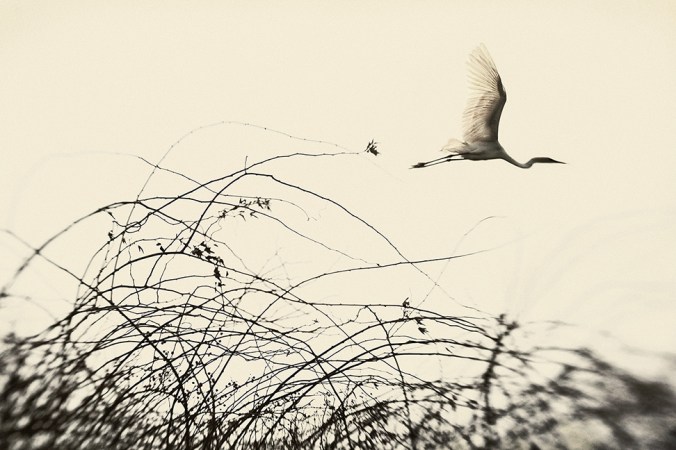
When despair for the world grows in me
and I wake in the night at the least sound
in fear of what my life and my children’s lives may be,
I go and lie down where the wood drake
rests in his beauty on the water, and the great heron feeds.
I come into the peace of wild things
who do not tax their lives with forethought
of grief. I come into the presence of still water.
And I feel above me the day-blind stars
waiting with their light. For a time
I rest in the grace of the world, and am free.
– Wendell Berry
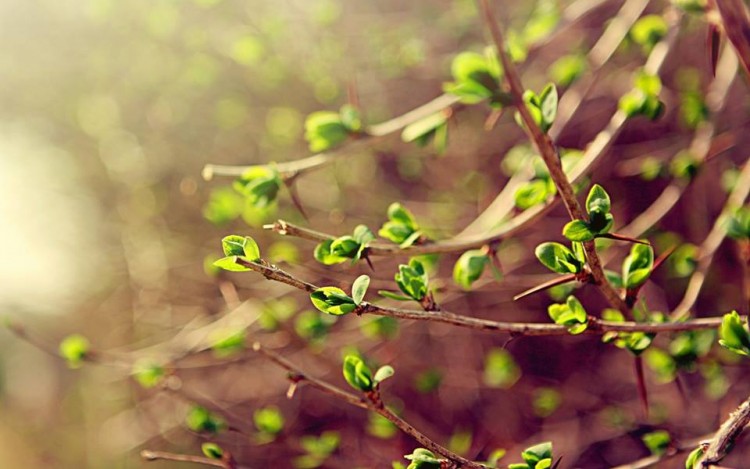
The same stream of life that runs
through my veins night and day runs
through the world and dances in rhythmic measures.
It is the same life that shoots in joy
through the dust of the earth in numberless blades of grass and
breaks into tumultuous waves of leaves and flowers.
It is the same life that is rocked in the ocean-cradle
of birth and of death, in ebb and in flow.
I feel my limbs are made glorious by the touch of this world
of life. And my pride is from the life-throb of ages
dancing in my blood this moment.
—Rabindranath Tagore, Gitanjali, LXIX
“A human being is part of a whole, called by us the ‘Universe’ —a part limited in time and space. He experiences himself, his thoughts, and feelings, as something separated from the rest—a kind of optical delusion of his consciousness. This delusion is a kind of prison for us, restricting us to our personal desires and to affection for a few persons nearest us. Our task must be to free ourselves from this prison by widening our circles of compassion to embrace all living creatures and the whole of nature in its beauty.”
Einstein – The Einstein Papers

Mother Earth
 earthy mindfulness